
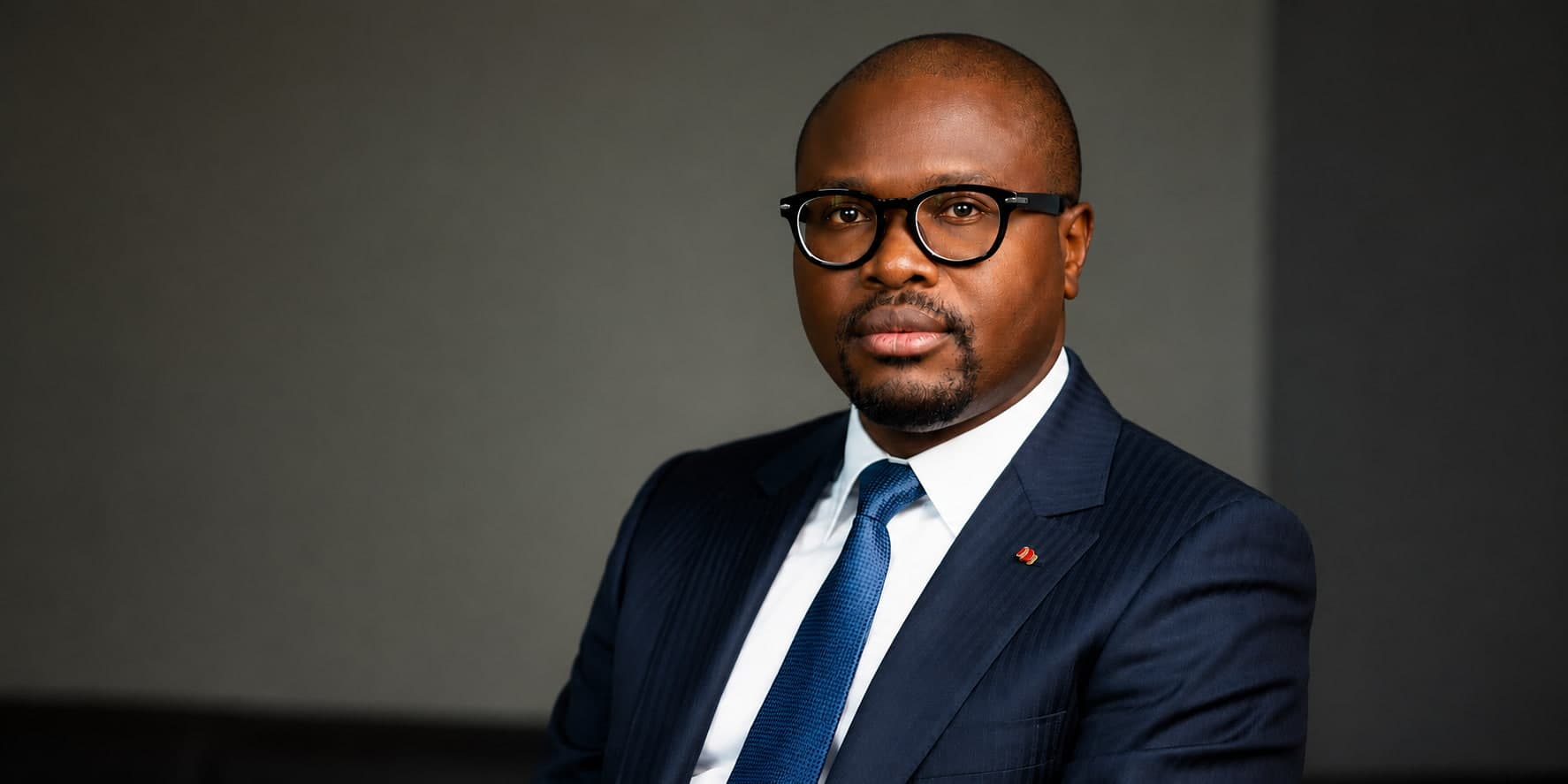
There is a particular kind of power in West African politics that rarely gets its due — the power of the person who makes the numbers work while the president takes the credit. Romuald Wadagni exercised that power for ten years in Benin, and exercised it with sufficient distinction that when President Patrice Talon's constitutional term expired, the ruling coalition did not search far for a successor. They turned to the man who had been running the economy.
For a decade, Benin's new president was the behind-the-scenes architect of sweeping economic reforms that produced one of the strongest growth rates in West Africa. The transition from finance minister to head of state is, in that context, less a political ascent than a formal acknowledgment of authority that had already been earned.
The Numbers That Built a Reputation
When Wadagni took over as Finance Minister in April 2016, Benin's GDP growth stood at 3.3 percent. By 2024 it had reached 7.5 percent. Growth is projected at around 7 percent in 2026 — the highest rate in the WAEMU zone. That trajectory, sustained across a decade that included a global pandemic, a regional security crisis, and multiple external shocks, is the foundation on which his presidency rests.
The fiscal record is equally precise. Under his tenure, Benin's public finances were cleaned up, with the budget deficit cut by a third and brought down to three percent of GDP. The tax-to-GDP ratio rose from 13 percent to 15.5 percent between 2017 and 2024. Inflation was contained at 2.2 percent in 2024, while public debt projected at 52.4 percent of GDP remains well below the regional threshold of 70 percent.
These are not vanity statistics. They represent the transformation of a state that had been fiscally unreliable into one that institutional investors take seriously — a transformation with direct and measurable consequences for the cost of capital available to Benin's development programme.
The Capital Markets Pioneer
Wadagni's most consequential contribution to Benin's economic story may be the one least visible to ordinary citizens: his systematic repositioning of the country within international capital markets.
He oversaw multiple Eurobond issuances — notably a €1 billion dual-tranche bond in 2021 including a 31-year maturity, one of the longest for any African sovereign, and Africa's first SDG-linked Eurobond. These were not routine financing transactions. They were signals — to rating agencies, to institutional investors, and to the broader development finance community — that Benin was a different kind of African sovereign borrower: disciplined, transparent, and serious about the relationship between borrowed capital and development outcomes.
In January 2025, Benin raised one billion euros and dollars — split between a $500 million 16-year Eurobond and €500 million in a structured loan guaranteed by IDA — a world first. The same year, Standard & Poor's upgraded Benin to BB- with a stable outlook. Wadagni was named Africa's best finance minister at the end of 2024.
The investment flows that followed confirm the market's judgment. FDI inflows rose from $174 million in 2020 to $433.85 million in 2023, with the stock of FDI reaching $3.71 billion by year-end.
Building the Productive Base
Macroeconomic discipline was the foundation. But Wadagni and Talon understood that fiscal stability without structural transformation produces growth that does not reach enough people. The Glo-Djigbé Industrial Zone, launched in 2021, is the most visible expression of that understanding.
These are not vanity statistics. They represent the transformation of a state that had been fiscally unreliable into one that institutional investors take seriously — a transformation with direct and measurable consequences for the cost of capital available to Benin's development programme. When Wadagni took over in 2016, GDP growth stood at 3.3 percent. By 2024 it had reached 7.5 percent — the highest rate in the WAEMU zone.
The 1,640-hectare zone processes products including cotton, cashew nuts, soy, shea, and pineapple. Textile units processed nearly 40,000 tonnes of cotton in 2024. More than 170 billion CFA francs has been invested and over 14,000 jobs created. This is the logic of African industrialisation applied in practice: take the raw material that the continent produces in abundance, add value before export, and capture the margin that has historically leaked to processors abroad.
The GDIZ is not yet at scale. But it is a functioning proof of concept for a model that the rest of the continent's economic policymakers are watching closely.
The Incomplete Picture
A WealthAfrica analysis would be incomplete without acknowledging what the economic record does not yet resolve.
The political environment in which Wadagni's victory occurred is not without complication. International observers characterised the 2026 election as neither free nor fair. No credible opposition candidate was allowed on the ballot, and the primary opposition party, the Democrats, failed to field a candidate. Wadagni won 94 percent of the vote against a sole token opponent whose party subsequently joined forces with Wadagni's coalition in parliament.
The governance question matters for investors not as an abstraction but as a risk variable. Institutions that function well under constrained competition can become fragile when the mechanisms of accountability are absent. Wadagni's record at the Finance Ministry suggests a technocrat with genuine commitment to institutional quality. Whether that commitment survives the different pressures of the presidency — where political considerations are inescapable and the room to operate as a pure technocrat narrows — is a question that a seven-year term will answer.
The security challenge in the north is equally real. Benin battles jihadist violence attributed mainly to al-Qaeda's Sahel branch, JNIM, and Wadagni has pledged that Benin will not yield to fear or complacency. Managing an insurgency while sustaining 7 percent GDP growth and the confidence of international capital markets is a test that no economic track record can fully prepare a leader for.
What the Technocrat Must Now Become
Wadagni enters the presidency with the rarest possible credential for an African head of state: a proven economic record that is his own, not inherited. The reforms he is expected to continue are reforms he designed. The investor relationships he will leverage are relationships he built. The credibility he carries into his first year in office was earned, not conferred.
The question that his presidency poses — for Benin, and for the broader African investment community — is whether technocratic competence at the finance ministry translates into the kind of transformational leadership that a presidency demands. The two jobs require overlapping but distinct skills. Managing numbers and managing nations are related disciplines, but they are not the same.
What is certain is that Benin arrives at this transition in a stronger position than it has occupied in a generation. With growth averaging more than six percent over the decade, Wadagni and Benin have won the backing of international investors. The platform is solid. The mandate is his.
The technocrat's moment has come. What he does with it will define whether Benin's decade of reform becomes the foundation of something durable — or the peak of a cycle that is easier to build than to sustain.
WealthAfrica is a Pan-African investment facilitation publication headquartered in New York. This Special Report is part of WealthAfrica's ongoing coverage of governance transitions and their implications for African investment markets.