
There is a question that every investor, every tourism operator, every development finance institution, and every Sierra Leonean who has ever sat on a ferry watching Freetown recede into the distance has asked themselves, in one form or another: why is the airport on the wrong side of the water?
The answer, of course, is history. Freetown International Airport — formerly known as Lungi International Airport — occupies a Royal Air Force base that the British established during World War II on the northern shore of the Sierra Leone River estuary. When independence came and the country needed a proper gateway to the world, Lungi was already there, already built, already operational. Infrastructure follows the logic of its era.
But history is not destiny. And the question that matters for Sierra Leone in 2026 is not why the airport is where it is — it is what the country is going to do about it.
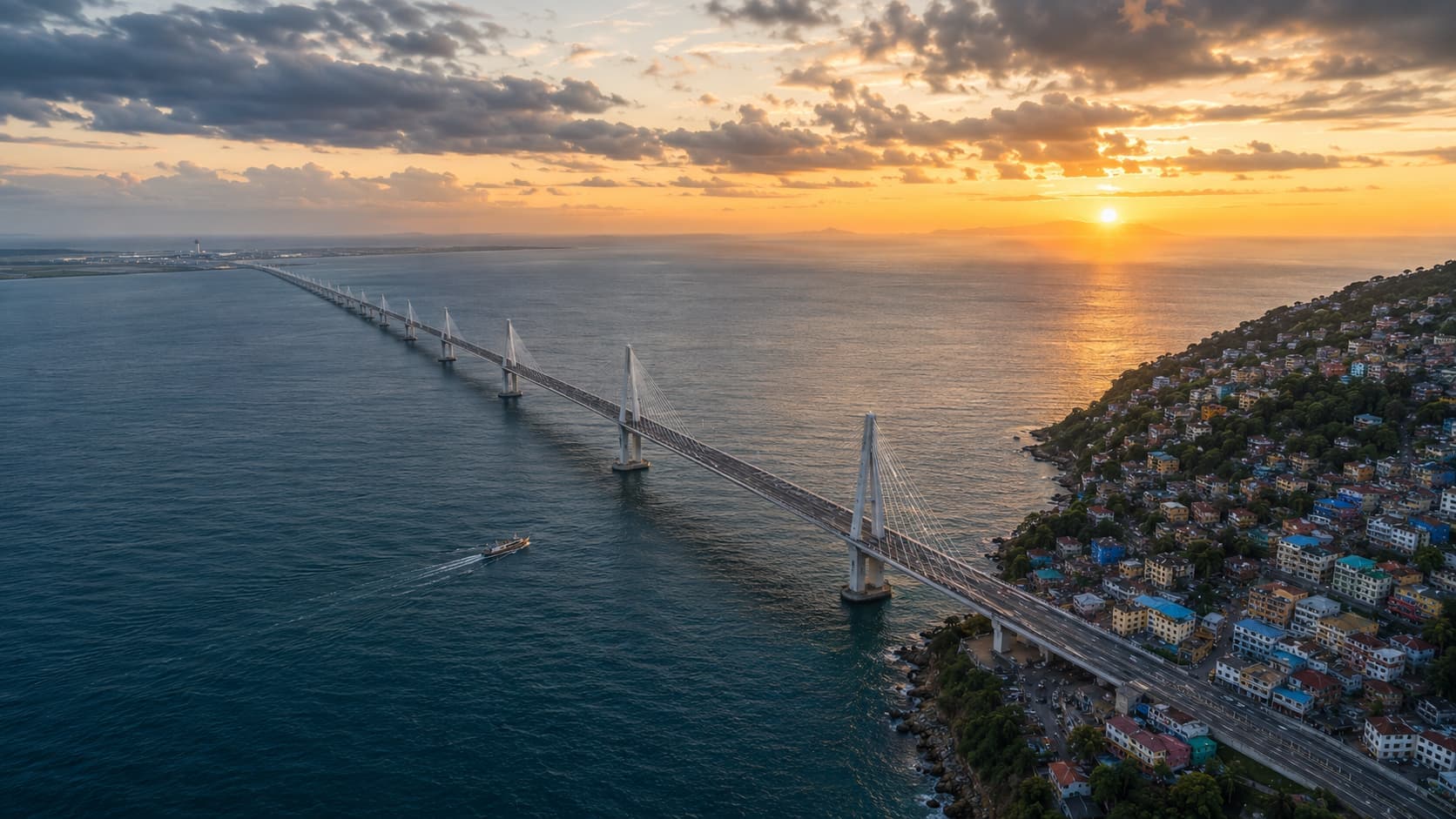
The Lungi Bridge is the answer. A 7-kilometre fixed crossing linking Freetown to its international airport, reducing a journey that currently consumes up to three hours and demands a sea crossing into a drive that would take less than fifteen minutes. It is, on the surface, a connectivity project. In reality, it is something far more significant: it is the infrastructure decision that would determine whether Sierra Leone's economic potential is realised in this generation or deferred to the next.
The Airport Paradox
To understand what the bridge would mean, you first have to understand what Sierra Leone has already built — and what it is currently unable to fully use.
In March 2023, Sierra Leone opened a new terminal at Freetown International Airport. The facility cost $270 million. It was designed with annual capacity for one million passengers and the ability to handle eight wide-body aircraft simultaneously. By any measure of African airport infrastructure, it is a serious, modern, internationally capable facility — the kind of gateway that signals a country is open for business, ready for volume, and building for the future.
In 2024, the airport processed approximately 248,000 passengers.
One million in capacity. Two hundred and forty-eight thousand in reality. A $270 million gateway operating at roughly one quarter of its designed throughput.
This is not a failure of ambition. Sierra Leone built the right airport. The problem is that the airport sits on the wrong side of an estuary from the country's capital, its commercial centre, its hotels, its government, and its population — and getting between the two requires either a sea crossing subject to weather, safety risks, and operational limitations, or a road journey of up to three hours that winds around the estuary through terrain that defeats the purpose of air travel entirely.
The bridge would not merely improve the airport journey. It would transform the airport from an aspirational asset into a functional economic engine. The gap between 248,000 passengers and one million is not a marketing problem. It is an access problem. And access problems have infrastructure solutions.
What Seven Kilometres Can Do: The Evidence
The sceptic will argue that a bridge is a bridge — useful, certainly, but not transformational. The evidence from comparable infrastructure investments across the world argues otherwise.
The most instructive case is the Øresund Bridge, which has linked Copenhagen, Denmark to Malmö, Sweden since the year 2000. Before the bridge, two major cities separated by sixteen kilometres of water maintained the kind of polite but commercially disconnected relationship that physical barriers impose. After the bridge, something altogether different emerged.
In the decade following the bridge's opening, the Swedish portion of the Øresund region recorded a 21% increase in GDP and a 17% increase in employment. The Danish side recorded a 12% GDP increase over the same period. An independent economic assessment estimated that the bridge generated more than €8 billion in economic value in its first twelve years — against a construction cost of approximately €4 billion. The infrastructure paid for itself twice over, in little more than a decade, in measurable economic output alone. That calculation excludes the quality-of-life gains, the social integration, the cultural exchange, and the scientific collaboration that a connected region produces as a matter of course.
One million in capacity. Two hundred and forty-eight thousand in reality. A $270 million gateway operating at roughly one quarter of its designed throughput. Sierra Leone built the right airport. The problem is that it sits on the wrong side of an estuary from the country's capital — and getting between the two requires a sea crossing subject to weather, safety risks, and operational limitations, or a road journey of up to three hours that defeats the purpose of air travel.
Cross-border commuting across the Øresund increased by more than 400% after the bridge opened. Over 100 Swedish companies relocated their headquarters to Malmö to access Copenhagen's economic infrastructure. A unified labour market emerged where two fragmented ones had existed before.
The Øresund case is not a perfect parallel — Denmark and Sweden are wealthier, more institutionally developed economies than Sierra Leone. But the underlying mechanism is identical and universal: physical barriers suppress economic activity below its natural level, and removing those barriers releases economic energy that was always present but unable to flow. The scale of the release is proportional to the scale of the opportunity that was being suppressed.
In Sierra Leone's case, the opportunity being suppressed is extraordinary.
The Tourism Equation
Sierra Leone possesses one of West Africa's most compelling natural tourism propositions. The country's Atlantic coastline runs for over 500 kilometres, encompassing beaches — Bureh, River No. 2, Tokeh — that rank among the continent's finest and remain, by regional standards, almost entirely undiscovered by international tourism. The interior offers Outamba-Kilimi National Park, chimpanzee sanctuaries, and a landscape of rivers and forest that ecotourism markets increasingly seek. The country's history, its cultural vitality, its food, and its people complete a package that, in any country with the infrastructure to match its endowments, would be generating hundreds of millions of dollars annually from international visitors.
It is not. Sierra Leone's tourism receipts in 2023 stood at approximately $91 million. Current projections, continuing the existing trajectory, reach $109 million by 2028. For context, Morocco — a country with comparable natural beauty but dramatically superior connectivity — recorded tourism revenues representing nearly 7% of national GDP in 2024, drawing tens of millions of visitors annually.
The constraint in Sierra Leone is not product. It is access. And access starts at the airport.
An international visitor arriving at Freetown International Airport today faces an immediate choice that no tourism marketing campaign can resolve: spend up to three hours reaching the city through one of the most challenging journeys any modern airport imposes on its arrivals, or take a sea crossing that, at night, in poor weather, or during peak periods, presents its own risks and frustrations. Neither option is compatible with the expectation of ease that international tourism markets demand. Visitors with alternatives — and they always have alternatives — choose those alternatives.
The bridge changes this calculus completely. A fifteen-minute drive from terminal to city centre transforms Freetown International Airport from an obstacle into an asset. It brings Sierra Leone's beaches, its national parks, its capital's culture and cuisine, and its investment environment within the friction-free reach that modern travellers and businesspeople require. Hotels become viable. Boutique resorts become investable. Airline routes that currently cannot justify the passenger volumes they require become commercially rational.
The $91 million in annual tourism receipts is not a ceiling imposed by Sierra Leone's attractiveness. It is a floor — the minimum that leaks through despite the access barrier. Remove the barrier, and the economics of Sierra Leone's tourism industry reset entirely.
The Investment Gateway
Tourism is the visible, human face of what the bridge enables. But the deeper economic prize is what the bridge does to Sierra Leone's investment environment.
Investment decisions are made on the basis of risk and return. Physical connectivity is a direct input into both sides of that equation. A country whose capital city is difficult to reach from its only international airport carries a risk premium in the minds of investors, business travellers, and corporate decision-makers that no amount of incentive packaging can fully offset. The friction of arrival communicates something about the ease of doing business before a single meeting has been held.
The bridge eliminates that friction. And in doing so, it changes the first impression that Sierra Leone makes on every visitor who arrives to evaluate whether to invest, to partner, to establish operations, to deploy capital.
The Koya Industrial Zone — one of the most significant manufacturing investments in Sierra Leone's recent history — requires reliable, efficient logistics to function at scale. The ARISE IIP platform being developed at Koya is designed to attract investors across agro-processing, pharmaceuticals, consumer goods manufacturing, and export industries. Those investors need to be able to move people and goods with confidence. A connected capital, reachable from the airport in minutes rather than hours, is part of the infrastructure of confidence that serious industrial investment requires.
The $91 million in annual tourism receipts is not a ceiling imposed by Sierra Leone's attractiveness. It is a floor — the minimum that leaks through despite the access barrier. A fifteen-minute drive from terminal to city centre would transform Freetown International Airport from an obstacle into an asset, making hotels viable, boutique resorts investable, and airline routes commercially rational. Remove the barrier, and the economics of Sierra Leone's tourism industry reset entirely.
Bumbuna II, the $750 million hydroelectric project that would nearly triple Sierra Leone's generation capacity, will require years of construction activity, technical expertise, and international contractor presence. The engineers, the financiers, the oversight teams, and the international partners involved in a project of that scale will pass through Freetown International Airport. The quality of their experience on arrival — and departure — is a small but real input into their perception of the country they are working in.
Infrastructure compounds. A bridge to an airport that serves an industrial zone powered by clean energy creates an investment environment qualitatively different from any of those elements in isolation.
The Water That Remains
One clarification that the bridge's critics occasionally raise deserves a direct response: if a bridge is built, what happens to the water crossing?
The answer is that it is freed for its highest use.
The ferry crossing between Freetown and Lungi, currently burdened with the unglamorous necessity of moving commuters, freight, and airport passengers back and forth across the estuary, would be liberated from that duty entirely. What remains is one of West Africa's most spectacular natural water corridors — a wide, navigable estuary opening onto the Atlantic, flanked by the Freetown Peninsula's green hills on one side and the broad coastal plain on the other.
That is a tourism asset. Water taxi services, leisure cruises, sport fishing charters, sunset excursions, and waterfront dining experiences are the commercial activities that naturally emerge when a water crossing stops being a commuter necessity and becomes a leisure choice. The estuary that currently frustrates visitors can become a feature that delights them. The economies of Freetown's waterfront and Lungi's coastal communities would both benefit from this transition.
The bridge does not eliminate the water. It changes its role in the economy from obstacle to opportunity.
The Case, Simply Stated
Sierra Leone has a $270 million airport built for one million passengers that processed 248,000 last year. It has a coastline capable of generating hundreds of millions in tourism revenue that currently produces $91 million. It has industrial investment arriving that needs logistical confidence to scale. It has a capital city that sits within sight — literally, across a stretch of water — of its only international gateway, yet remains separated from it by a journey that defeats the purpose of proximity.
The Lungi Bridge resolves all of these contradictions simultaneously. Seven kilometres of fixed infrastructure connecting an airport to a capital city is not a prestige project or a political ambition — it is the single intervention with the broadest and deepest economic multiplier effect of any infrastructure investment available to Sierra Leone today.
The Øresund Bridge doubled its construction cost in economic value within twelve years of opening. It did so in a wealthy European context with mature institutions and existing economic density. Sierra Leone, at an earlier stage of development and with greater unrealised potential, offers a steeper curve of return on the same fundamental investment logic.
The question that matters is not whether Sierra Leone can afford to build this bridge.
It is whether Sierra Leone can afford not to.
WealthAfrica is a Pan-African investment facilitation publication headquartered in New York, with operational presence across West Africa. This article is part of an upcoming WealthAfrica Sierra Leone Special Edition, examining the country's economic trajectory at a pivotal moment in its governance history.