
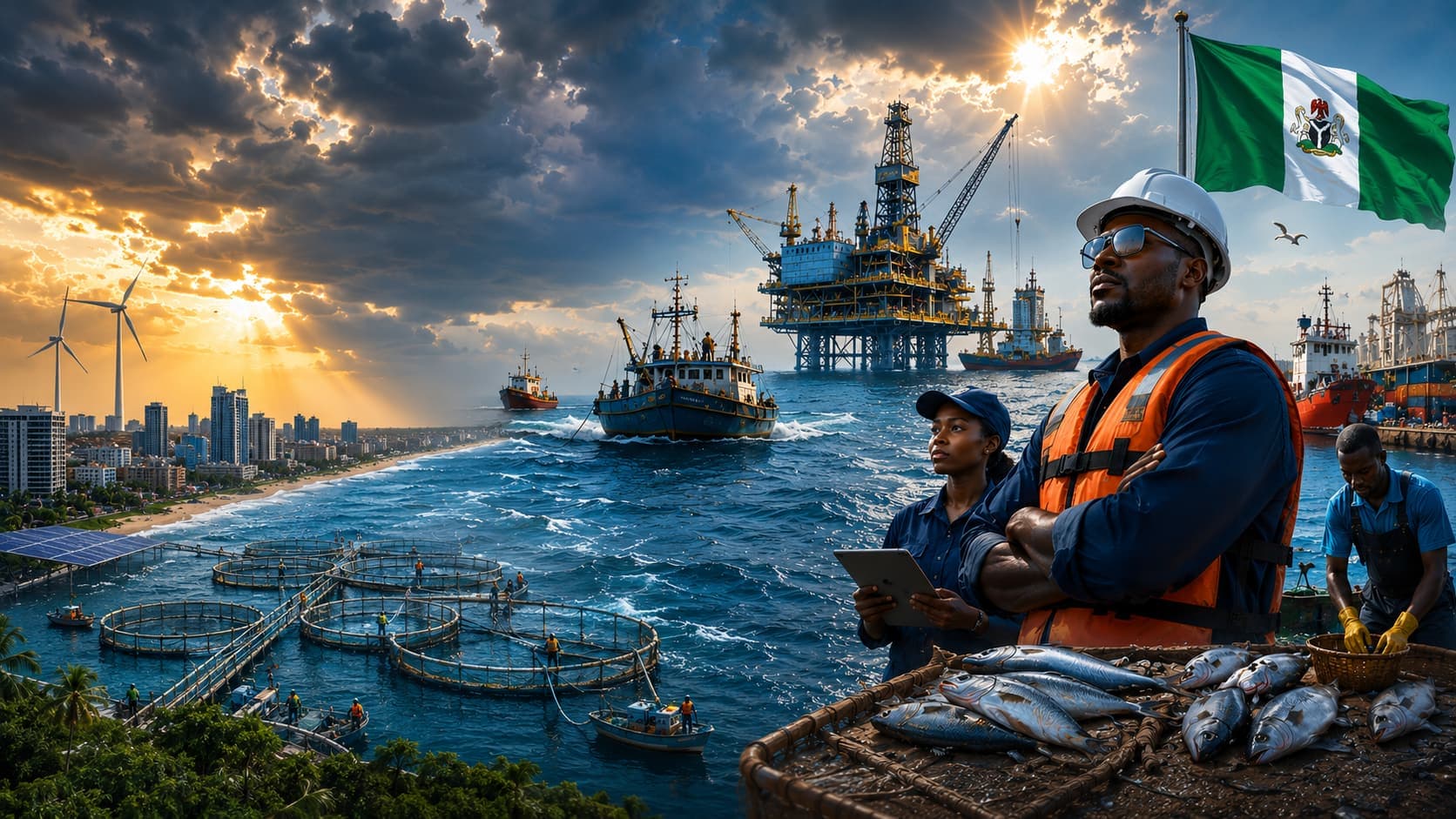
Nigeria's 853 kilometres of coastline stretching from the border with Benin in the west to Cameroon in the east represents one of the most underutilised economic frontiers on the African continent. Pair this with an Exclusive Economic Zone spanning over 200,000 square kilometres into the Gulf of Guinea, and you begin to understand why serious analysts refer to Nigeria's blue economy not as an opportunity but as an obligation.
The question is not whether Nigeria can build a $500 billion blue economy. The evidence suggests it can. The question — as it always is in Nigeria — is one of leadership, coordination, and the political will to convert natural endowment into institutional capacity.
The Scale of What Is Being Left on the Table
When the World Bank estimates that the global ocean economy generates $1.5 trillion annually and projects this to reach $3 trillion by 2030, Nigeria's share of that figure should, by any rational calculation, run into the hundreds of billions. The country sits at the intersection of Atlantic shipping lanes, hosts West Africa's largest port complex at Apapa and Tin Can Island, and commands fisheries whose current exploitation represents a fraction of their sustainable yield.
The offshore energy sector alone — encompassing oil and gas production, the emerging floating LNG segment, and the nascent offshore wind potential in the Gulf of Guinea — places Nigeria among the handful of African nations with the resource base to develop genuinely world-scale blue economy infrastructure. Add coastal tourism, aquaculture, deep-sea mining rights, submarine cable landing infrastructure, and the maritime logistics ecosystem that serves the entire West African sub-region, and the $500 billion figure begins to feel not like an aspiration but like a conservative floor.
Yet a review of Nigeria's National Blue Economy Policy reveals a familiar pattern: ambitious targets, elegant frameworks, and a persistent gap between articulation and execution. The National Integrated Infrastructure Master Plan acknowledges the maritime sector. The Blue Economy Policy identifies twelve priority sectors. Coordination between the Nigerian Maritime Administration and Safety Agency, the Ministry of Agriculture and Food Security, the Ministry of Petroleum Resources, and state governments with Atlantic coastlines remains fragmentary at best.
The Leadership Problem Stated Plainly
Nigeria's blue economy challenge is not primarily a technical or financial problem. It is a governance problem. Specifically, it is a coordination problem of the kind that Nigeria has repeatedly demonstrated it can solve when the political will exists — and repeatedly failed to solve when it does not.
The successful development of the Lekki Deep Sea Port, which commenced commercial operations in 2023, is instructive. The port — capable of handling the largest container vessels in the Atlantic trade — was delivered through a structured public-private partnership that brought together Chinese financing, Nigerian private sector commitment, and sustained political backing from Lagos State. When those three elements aligned, a world-class piece of maritime infrastructure was built. The model exists. The question is whether it can be replicated at scale across the full blue economy opportunity rather than in isolated pockets.
What the Lekki model required — and what Nigeria's broader blue economy development currently lacks — is a single accountable authority with the mandate, the funding, and the political protection to drive cross-ministerial coordination. The Blue Economy Policy nominally assigns this role to the Federal Ministry of Marine and Blue Economy, created in 2023 under President Tinubu's administration. The ministry's creation was a significant structural acknowledgment of the sector's importance. Whether it becomes a genuine coordination hub or another institutional layer competing for bureaucratic territory will be determined by the quality of its leadership and the seriousness of presidential backing behind it.
Yet a review of Nigeria's National Blue Economy Policy reveals a familiar pattern: ambitious targets, elegant frameworks, and a persistent gap between articulation and execution. The National Integrated Infrastructure Master Plan acknowledges the maritime sector. The Blue Economy Policy identifies twelve priority sectors. Coordination between the Nigerian Maritime Administration and Safety Agency, the Ministry of Agriculture, the Ministry of Petroleum Resources, and state governments with Atlantic coastlines remains fragmentary at best.
Where the Investment Opportunity Lies Today
For institutional investors and development finance institutions assessing Nigeria's blue economy, the near-term opportunity is concentrated in three areas where the commercial fundamentals are clearest and the policy environment most supportive.
Port and logistics infrastructure expansion remains the most bankable segment. The AfCFTA-driven growth in intra-African trade creates structural demand for expanded terminal capacity, cold chain logistics for agricultural exports, and dry port development connecting maritime gateways to northern Nigerian markets and beyond to the Sahel. These are long-duration assets with predictable demand profiles — exactly the risk-return characteristics that infrastructure funds seek.
Offshore energy infrastructure presents a different risk profile but a larger prize. Nigeria's gas monetisation agenda, the drive to expand LNG export capacity, and the emerging regulatory framework for offshore renewable energy create a pipeline of projects in which international energy majors and infrastructure funds are already conducting feasibility assessments. The uncertainty is regulatory — Nigeria's history of contractual instability in the petroleum sector remains a live risk that no governance reform has yet fully neutralised.
Aquaculture and fisheries represent the most underdeveloped segment of Nigeria's blue economy but arguably the most consequential from a food security and employment perspective. Nigeria imports approximately $1 billion worth of fish annually — a figure that should not be possible given the country's maritime endowment. Integrated aquaculture investments combining hatchery infrastructure, cold chain logistics, and processing capacity have demonstrated commercial viability in comparable markets. The constraints are access to finance for smaller operators, inconsistent regulatory enforcement of illegal fishing, and the absence of anchor investors willing to take the development-phase risk.
The Tinubu Administration's Window
President Tinubu's administration enters its third year having made the right structural decisions — the ministry creation, the policy frameworks, the stated commitment to blue economy development as a pillar of economic diversification. The structural decisions are necessary but insufficient. What converts structural decisions into economic outcomes is sustained, senior-level attention to implementation.
Nigeria's blue economy has a window. African Development Bank financing is available. International investor appetite for African maritime infrastructure — particularly in energy and logistics — is higher than at any point in the past decade. The AfCFTA tailwind is real. The demographic pressure that makes food security an urgent rather than long-term imperative is intensifying.
The $500 billion question is not whether the opportunity exists. It is whether the administration that has correctly identified the opportunity will stay focused on it long enough, and manage the coordination challenges seriously enough, to convert Nigeria's maritime endowment from a figure in a policy document into an engine of national economic transformation.
The ocean has been waiting. The question — as always — is whether Nigeria is ready to meet it.