
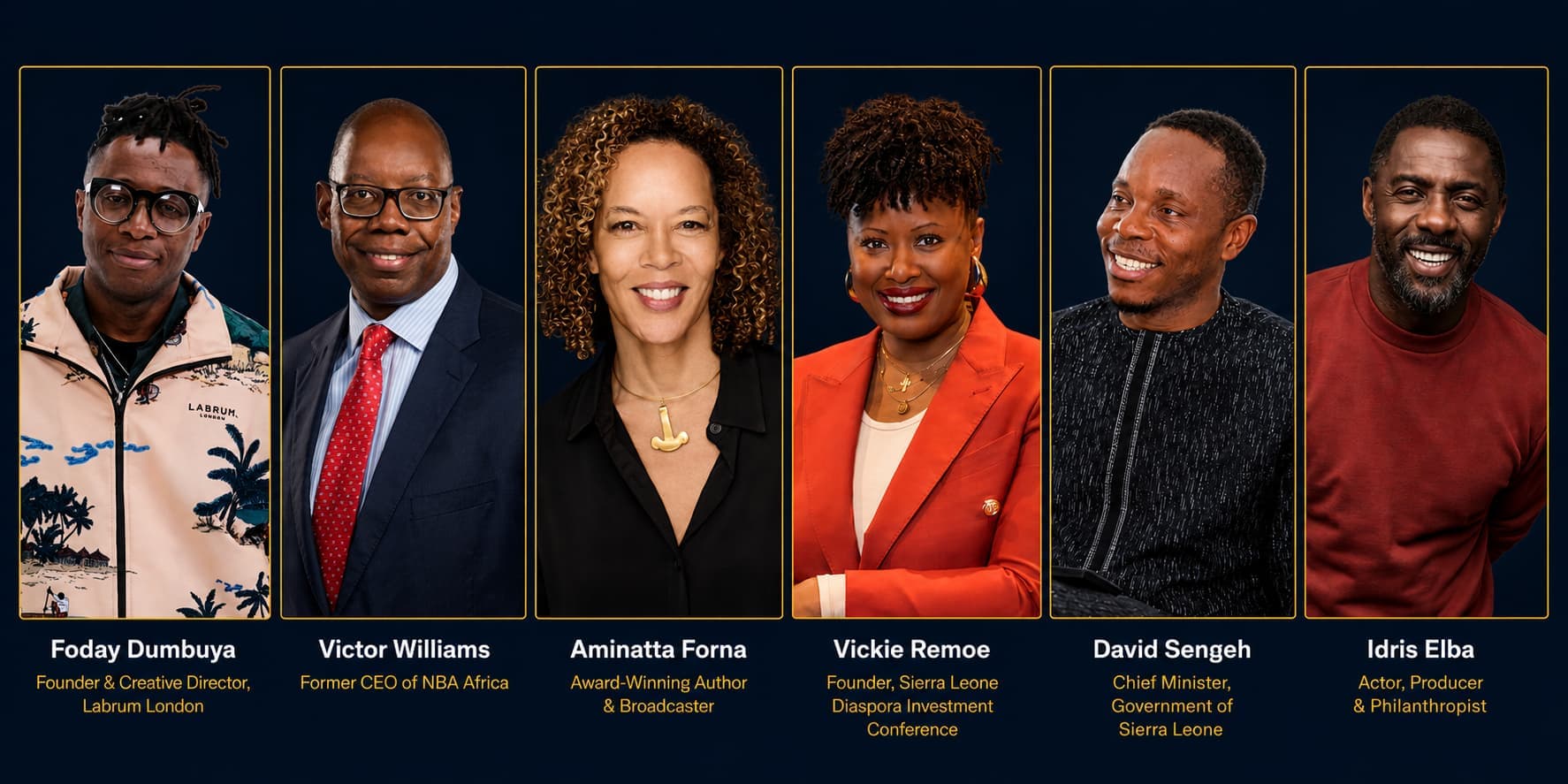
In the summer of 2024, a Sierra Leonean designer made history in one of the world's most commercially visible arenas. Foday Dumbuya, founder of the London-based menswear label Labrum London, became the first independent designer ever to create an on-field kit for a Premier League football club. The club was Arsenal. The kit — a black base adorned with hand-drawn zigzag patterns representing the movement of people, pan-African colours of red, green, and black, and Labrum's signature Nomoli icon, a symbol of protection and prosperity rooted in the Mende and Kissi traditions of Sierra Leone — was seen on the backs of some of the world's most watched athletes, in stadiums across England and Europe, broadcast to hundreds of millions of viewers globally.
Dumbuya did not merely design a football shirt. He embedded Sierra Leone's cultural vocabulary into one of the most commercially saturated, globally visible canvases in contemporary sport. The Nomoli — a figurine that Sierra Leonean communities have used for generations as a symbol of ancestral protection — appeared on the chest of Bukayo Saka at the Emirates Stadium.
This is what diaspora capital looks like when it is working at full power. And it is a glimpse of something Sierra Leone has only barely begun to recognise, let alone strategically harness.
The Visible Number and What It Hides
The standard frame for discussing Sierra Leone's diaspora is economic, and the numbers are significant. An estimated 336,000 Sierra Leoneans live outside the country, concentrated in the United Kingdom, the United States, Germany, the Netherlands, and neighbouring West African nations. Between 2020 and 2023 alone, this community sent nearly $1 billion in remittances to Sierra Leone — three times the $372 million sent in the preceding four years. Current annual remittance flows are estimated at between $232 million and $322 million, representing a crucial economic stabiliser for families and a non-trivial contribution to the national economy of a country with a nominal GDP of approximately $8.4 billion.
These numbers are real and they matter. In a country where extreme poverty affects roughly one in four citizens and where formal employment opportunities remain insufficient for a growing population, remittances function as a distributed social safety net that no government programme has yet matched in reach or reliability. They keep children in school, maintain households through illness, and absorb economic shocks that would otherwise be catastrophic at the family level.
But the remittance figure is the most visible and most easily measured layer of what the Salone diaspora represents. It captures money. It does not capture knowledge, networks, institutional exposure, governance experience, creative vision, or the accumulated professional capital of a community that has spent decades operating within some of the world's most demanding economies and institutions. When you account for those dimensions, the true value of Sierra Leone's diaspora is not $232 million annually. It is a multiple of that, in forms that a balance sheet cannot easily hold.
The question Sierra Leone must now ask — urgently, and with the seriousness it deserves — is how much of that broader value is being intentionally converted into national development, and how much is simply being left on the table.
The Architect of a Global Brand
Foday Dumbuya's path from Sierra Leone to the pinnacle of British fashion is not a story of accident. It is a story of deliberate identity — of a designer who understood, from the beginning, that his origin was not a liability to be managed but a resource to be deployed.
Born in Sierra Leone, Dumbuya spent part of his youth in Cyprus before settling in London, where he studied at Nottingham Trent University and honed his craft at DKNY and Nike before founding Labrum London in 2014. The brand's name itself — drawn from an old cartographic reference to Sierra Leone — announced its intention from the outset: this was fashion that would make the country's history visible in spaces it had never previously occupied.
In May 2023, King Charles III presented Dumbuya with the Queen Elizabeth II Award for British Design, with David Beckham in attendance. In July 2024, Labrum's Arsenal collaboration was announced. Alongside it, Dumbuya designed the official kit for Team Sierra Leone at the Paris 2024 Olympic Games. In one season, Sierra Leonean cultural heritage appeared in a Premier League stadium, at the Olympic Games, and featured prominently in the Business of Fashion.
The commercial logic is as important as the cultural symbolism. Labrum London generates revenue, employs people, and builds brand equity in one of the world's most competitive industries. Dumbuya is not a cultural ambassador in the honorary sense. He is an entrepreneur who has built a globally competitive business using Sierra Leonean heritage as its primary creative engine. That distinction matters for how Sierra Leone should think about its diaspora: not as a source of donations or goodwill, but as a reservoir of commercially viable, institutionally connected, globally active talent.
The Standard Setter
The remittance figure is the most visible and most easily measured layer of what the Salone diaspora represents. It captures money. It does not capture knowledge, networks, institutional exposure, governance experience, creative vision, or the accumulated professional capital of a community that has spent decades operating within some of the world's most demanding economies and institutions. The true value of Sierra Leone's diaspora is not $232 million annually. It is a multiple of that, in forms that a balance sheet cannot easily hold.
If Dumbuya represents what diaspora cultural capital looks like converted into commercial success, Victor Williams represents what it looks like converted into institutional finance power.
A dual citizen of Sierra Leone and the United States, Williams holds degrees in applied mathematics and economics from Brown University and an MBA from Harvard Business School. Before returning to the continent, he worked as an investment banker at Goldman Sachs and Wells Fargo Securities. He then served as Executive Head of Corporate and Investment Banking for Standard Bank Group across nineteen countries in sub-Saharan Africa — one of the most senior roles in African corporate finance. In August 2020, he was appointed CEO of NBA Africa, overseeing the league's basketball and business development initiatives across the continent, growing the Basketball Africa League, and expanding the NBA's commercial presence in a market of over one billion people.
He was named among the 100 Most Influential Africans by New African Magazine in 2021. He sits on the Harvard Business School Africa Advisory Board.
Williams is, in other words, a person with the credibility, the network, and the institutional knowledge to move significant capital. He is also Sierra Leonean. And his continued engagement with the diaspora community — including his participation in the Sierra Leone Diaspora Investment Conference — is a signal that the appetite exists, among the diaspora's most accomplished members, to connect their professional power to their homeland's development story.
The question is what structures Sierra Leone is building to receive and deploy that appetite.
The Voice the World Reads
Aminatta Forna OBE has spent three decades making Sierra Leone visible in the places where the world's intellectual and cultural elite form their opinions about countries they will never visit.
Born in Scotland to a Sierra Leonean father and Scottish mother, raised in Sierra Leone and Britain, Forna is the author of four internationally celebrated novels and a memoir, with her books translated into twenty-two languages. Her novel The Memory of Love — set in Sierra Leone's aftermath of civil war — won the Commonwealth Writers' Prize for Best Book in 2011. She holds the Windham Campbell Literature Prize from Yale University, was made an OBE in 2017 for services to literature, and currently directs the Lannan Center for Poetics and Social Practice at Georgetown University. Her essays appear in Granta, the New York Review of Books, the Guardian, and Vogue.
This matters in ways that are not purely cultural. The countries that attract investment, tourism, and institutional attention are countries that exist in the global imagination as real, complex, human places — not abstractions on a risk map. Literature performs that work. Forna's novels, set partly in Sierra Leone, have been read by millions of people who would not otherwise have formed any image of the country at all. They have placed Sierra Leone in the reading lists of universities, in the consciousness of literary communities in Europe and North America, and in the minds of precisely the educated, globally mobile professionals who make decisions about where to travel, where to invest, and which causes to support.
Forna has not left Sierra Leone behind. She founded the Rogbonko Project, a charity that has built a school in a Sierra Leonean village and expanded into adult education, sanitation, and maternal health. The intellectual engagement and the practical commitment exist simultaneously — which is the model the diaspora, at its best, always represents.
The Mobiliser
Vickie Remoe is, by any reasonable measure, one of the most consequential Sierra Leonean diaspora figures of the current era — not because of a single achievement, but because of what she has built and what it represents structurally.
A media personality, entrepreneur, and development advocate based in the United States, Remoe identified a gap that no institution had addressed: there was no dedicated, recurring platform for Sierra Leonean diaspora professionals and investors to connect systematically with each other and with opportunity back home. In 2023, she founded the Sierra Leone Diaspora Investment Conference. By its third annual edition in August 2025, the SLDIC had become the largest gathering of Sierra Leonean and American entrepreneurs, investors, and changemakers in North America, drawing over 300 participants and featuring speakers spanning finance, agriculture, technology, health, and policy.
The SLDIC's significance goes beyond the conference itself. It represents the diaspora organising — not waiting for the state to create structures, but building them independently. Its annual themes have moved deliberately from awareness toward action: from introducing the investment environment, to navigating market complexity, to equipping investors with tools for operating amid political and economic uncertainty. That progression reflects a community that is maturing from aspiration to execution.
Remoe was awarded a lifetime achievement award for service to the diaspora by the Sierra Leone High Commission in Washington DC in 2024. The recognition is fitting, but the more important measure of her contribution is the community she has built and the capital conversations she has catalysed.
A global celebrity using their platform to intervene in their country's democratic process, in the country's own language, days before a presidential election, is not performing heritage. It is citizenship in the deepest sense of the word — the exercise of responsibility toward a community you have formally claimed as your own. The diaspora's cultural influence operates at multiple registers simultaneously: from novels in the reading lists of the world's universities, to a Sierra Leonean citizen who happens to be one of Hollywood's most bankable stars delivering a Krio verse into the global streaming ecosystem days before his country votes.
The gap between Sierra Leone's remittance flows and its diaspora direct investment flows is still large. Closing it is the work of precisely the kind of infrastructure Remoe has created.
The One Who Came Home
No discussion of the Salone diaspora's potential is complete without confronting its most important question directly: what happens when the diaspora comes home?
David Sengeh could have remained abroad. His credentials made it not only possible but comfortable. A Sierra Leonean who earned his doctorate at the MIT Media Lab, delivered a TED Global talk, published in peer-reviewed journals on biomedical engineering and prosthetics, and built an international profile as one of the most credible voices on innovation and human-centred design in the developing world — Sengeh had every institutional doorway open to him in the global knowledge economy.
He chose to return. Appointed as Sierra Leone's Chief Innovation Officer in 2018, he drove the government's Free Quality School Education programme, arguably one of the most significant education policy interventions in the country's post-war history, expanding access to over one million children. He subsequently became Chief Minister — effectively the head of government operations — and has been the acknowledged intellectual architect of the Bio administration's forward-looking policy agenda, from digital governance to education reform to innovation infrastructure.
Sengeh is not a ceremonial appointment. He is a functioning executive who has translated global institutional knowledge into domestic policy at scale. And he is the answer, made flesh, to the question of what the diaspora's human capital can do when it is intentionally returned to the context that needs it most.
His case is also, necessarily, a challenge to the state. Sengeh came home partly because the right invitation was extended at the right moment. How many others — with equivalent competence, equivalent ambition, and an equivalent connection to Sierra Leone — are waiting for an invitation that has not yet arrived? How many have stopped waiting?
Nothing's Bigger than Elba
In 2019, the actor best known internationally for The Wire, Luther, and a string of major Hollywood productions, received a Sierra Leonean national passport and described it publicly as one of the best moments of his life.
Idris Elba's relationship with Sierra Leone is not just a heritage acknowledgment or mere cultural affiliation statement. He's made it clear that Sierra Leone is not just where his father came from — it is where he belongs.
Born in Hackney, London, to a Sierra Leonean father and Ghanaian mother, Elba has built one of the most recognisable careers in global entertainment. But the assumption that his Sierra Leonean identity was merely biographical — a footnote to a British career — is comprehensively disproved by the body of work he has built in deliberate partnership with the country.
His creative collaboration with Sierra Leonean artist Drizilik is the clearest evidence. "Ashobi," released in 2022, became a hit single that embedded Sierra Leonean cultural expression into a global entertainment platform. The two performed the track together live in Sierra Leone in 2024 — not a stadium in London or Los Angeles, but on home soil, in front of the people the music was made with and for. A film collaboration, Dust to Dreams, extends the creative partnership beyond music into cinema.
Most significant of all is "Vote" — released on June 20, 2023, by Drizilik featuring Idris Elba, days before the Sierra Leonean presidential election. The Afrobeat track was a deliberate civic intervention: an anthem for democratic participation, political awareness, and peaceful engagement, delivered in part by Elba in Krio — the English-based creole widely spoken across Sierra Leone — with an authenticity that regional audiences recognised and praised immediately.
A global celebrity using their platform to intervene in their country's democratic process, in the country's own language, days before a presidential election, is not performing heritage. It is citizenship in the deepest sense of the word — the exercise of responsibility toward a community you have formally claimed as your own.
A national diaspora strategy worthy of the asset would create clear, transparent pathways for diaspora professionals to re-enter the domestic economy without sacrificing the credentials and networks they have built abroad. It would treat the 336,000 Sierra Leoneans abroad not as a humanitarian resource to be thanked for their remittances, but as a strategic constituency to be engaged as partners in national development. The model exists elsewhere on the continent. Rwanda's diaspora engagement strategy has been credited as a meaningful contributor to the country's remarkable institutional recovery.
The diaspora's cultural influence operates at multiple registers simultaneously — from Aminatta Forna's novels in the reading lists of the world's universities, to Foday Dumbuya's Nomoli on the chest of Arsenal's starting eleven, to a Sierra Leonean citizen who happens to be one of Hollywood's most bankable stars delivering a Krio verse into the global streaming ecosystem days before his country votes. These are different instruments playing the same note: Sierra Leone exists, it is creative, it is present, and its people — wherever they are in the world — have not forgotten where they come from.
The Asset That Requires a Strategy
The six figures profiled in this piece represent different sectors, different geographies, different generations, and different modes of diaspora contribution. What they share is that none of their contributions was the product of a systematic national strategy. They emerged from individual ambition, personal connection, and in some cases, the right invitation at the right moment.
That is how diaspora assets work when they are left to self-organise. They produce remarkable individuals. They do not produce a coordinated development force.
Sierra Leone's government has acknowledged this gap. President Bio announced in October 2021 that he was pursuing a constitutional amendment to allow dual citizens greater political participation — a recognition that the diaspora's engagement requires structural invitation, not just cultural sentiment. The Sierra Leone Diaspora Investment Conference, now in its third year, has created an independent platform. These are encouraging signals.
But a national diaspora strategy worthy of the asset would go further. It would create clear, transparent pathways for diaspora professionals to re-enter the domestic economy — in government, in the private sector, in academia — without sacrificing the credentials and networks they have built abroad. It would establish diaspora investment vehicles that allow the community to deploy capital into Sierra Leone with the governance protections and return visibility that serious investors require. It would treat the 336,000 Sierra Leoneans abroad not as a humanitarian resource to be thanked for their remittances, but as a strategic constituency to be engaged as partners in national development.
The model exists elsewhere on the continent. Rwanda's diaspora engagement strategy has been credited as a meaningful contributor to the country's remarkable institutional recovery. Ethiopia's diaspora bond issuance, despite its imperfections, demonstrated that diaspora capital can be mobilised at scale when the right instruments exist. The lessons are available. The adaptation is Sierra Leone's work to do.
What the Diaspora Is Telling Sierra Leone
There is a message embedded in the collective biography of the Salone diaspora, and it is not subtle.
A designer puts Sierra Leonean cultural symbols on the jerseys of one of the world's most watched football clubs. A Harvard-trained finance executive builds pan-African institutional capital across nineteen countries. A novelist places Sierra Leone in the reading lists of the world's universities. A conference organiser builds the largest annual platform for diaspora investment in North America. A Chief Minister brings MIT-calibre governance thinking to a ministry in Freetown.
The message is: the talent is there. The ambition is there. The connection is there.
The question that Sierra Leone must answer — as this administration enters its final years and as the country prepares for a transition that will define the next decade — is whether the national architecture is being built to receive it.
The Salone diaspora is not waiting indefinitely. The world competes for its talent, its capital, and its energy. What Sierra Leone offers in return — stability, opportunity, institutional clarity, and a genuine invitation — will determine how much of what is described in this article eventually comes home.
WealthAfrica is a Pan-African investment facilitation publication headquartered in New York, with operational presence across West Africa. This editorial was produced as part of WealthAfrica's Sierra Leone Special Edition, examining the country's economic trajectory at a pivotal moment in its governance history.